

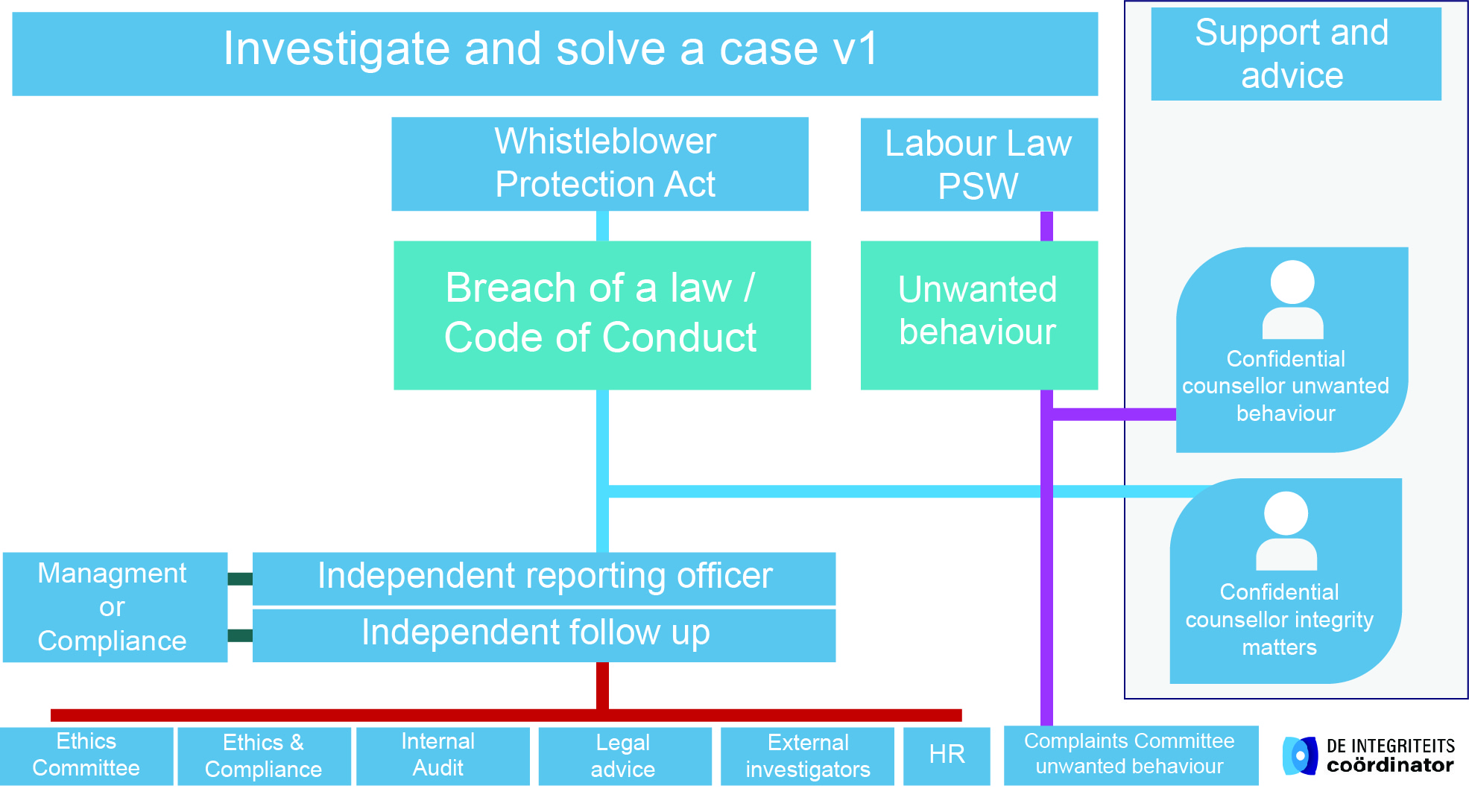
During the courses that we provide, we regularly discuss how to organise the reporting and follow-up channel. And how does this relate to the role of the confidential counsellors? We try to clarify this in this article with the help of three illustrations.
Dutch employers are obliged to combat psycho-social workpressure (PSW). This evolves from Dutch Labour Law. As a consequence, many Dutch employers have appointed confidential counsellors, who offer a listening ear to employees who are confronted with unwanted behaviour. The confidential counsellors can support and sometimes also advise employees who are struggling with this. That is, they usually don’t advise somebody what to do, but they can advise on potential next steps to be taken, what procedures are in place and some pros and cons of the various options. In addition, they can raise something with the employer on behalf of the employee. Confidential counsellors should be independent and not have conflicting interests. Therefore, it is not a good idea to give an employee from the HR, or Legal department or a member of the management the role of internal confidential counsellor.
Internal and/or external confidential counsellors can be appointed. Internal counsellors have the advantage of knowing the organisation better and being able to assess a situation better. However, they usually also have another role and may therefore have conflicting interests. External counsellors usually do not have other interests and are therefore more independent but are however somewhat less familiar with the organisation. Ideally, an employer should appoint both internal and external confidential counsellors. This is not an easy role, which is why training courses for confidential counsellors and a National Association of Confidential Counsellors exist. They establish the requirements for certification of confidential counsellors and maintain a register (Dutch language).
With the introduction of the House for Whistleblowers Act in 2016, some employers appointed confidential counsellors on integrity matters in addition to confidential counsellors for undesirable behaviour. Some counsellors combine both.
In doing so, the counsellors are not meant to act as reporting channels. The House for Whistleblowers has pointed this out in several brochures. After all, confidential counsellors should support employees and can also act on behalf of the employee. They are independent but not necessarily impartial. It also certainly does not seem right to us if confidential counsellors would conduct independent investigations.
That is why many employers have also set up a complaints committee, where reports of undesirable behaviour can be submitted, after which they are investigated. The majority of the members of such a complaints committee should consist of independent, external participants. They ensure, for instance, that both sides will be heard (interviewed) and then advise the management. Often, it is not possible to submit an anonymous report to the complaints committee because this makes it difficult to interview both sides.
With the introduction of the Dutch Whistleblower Protection Act, many organisations should nominate a whistleblowing reporting officer, as well as a person or department to follow up on the reports. Both roles should be fulfilled by independent people. These roles can also be combined. For example, the Integrity Coordinator BV can offer external, independent reporting and follow-up services. This function can also be fulfilled by an Ethics & Compliance Officer or Integrity Manager, provided they are sufficiently independent. This can be laid down in a Compliance Charter, for instance. It also helps if the Ethics & Compliance Officer has multiple reporting lines, for instance to the CEO as well as to the Supervisory Board or Audit Committee. Of course, this person must also have the required capabilities.
The reports which are received should be investigated by independent investigators. This can be done by an Internal Audit Department or external investigators. Depending on the findings, it may be appropriate to obtain advice from the Legal Department, Human Resources or an external lawyer. Organisations may also choose to have these matters handled and monitored by an Ethics Committee. In between, management should be informed, for example if the matter is important and may have serious consequences or to request a budget for the investigation or for legal advice. Ultimately, management also decides what corrective and preventive action to take. All the while, the follow-up officer communicates frequently with all the various parties involved, including the reporter. More in this and this article.
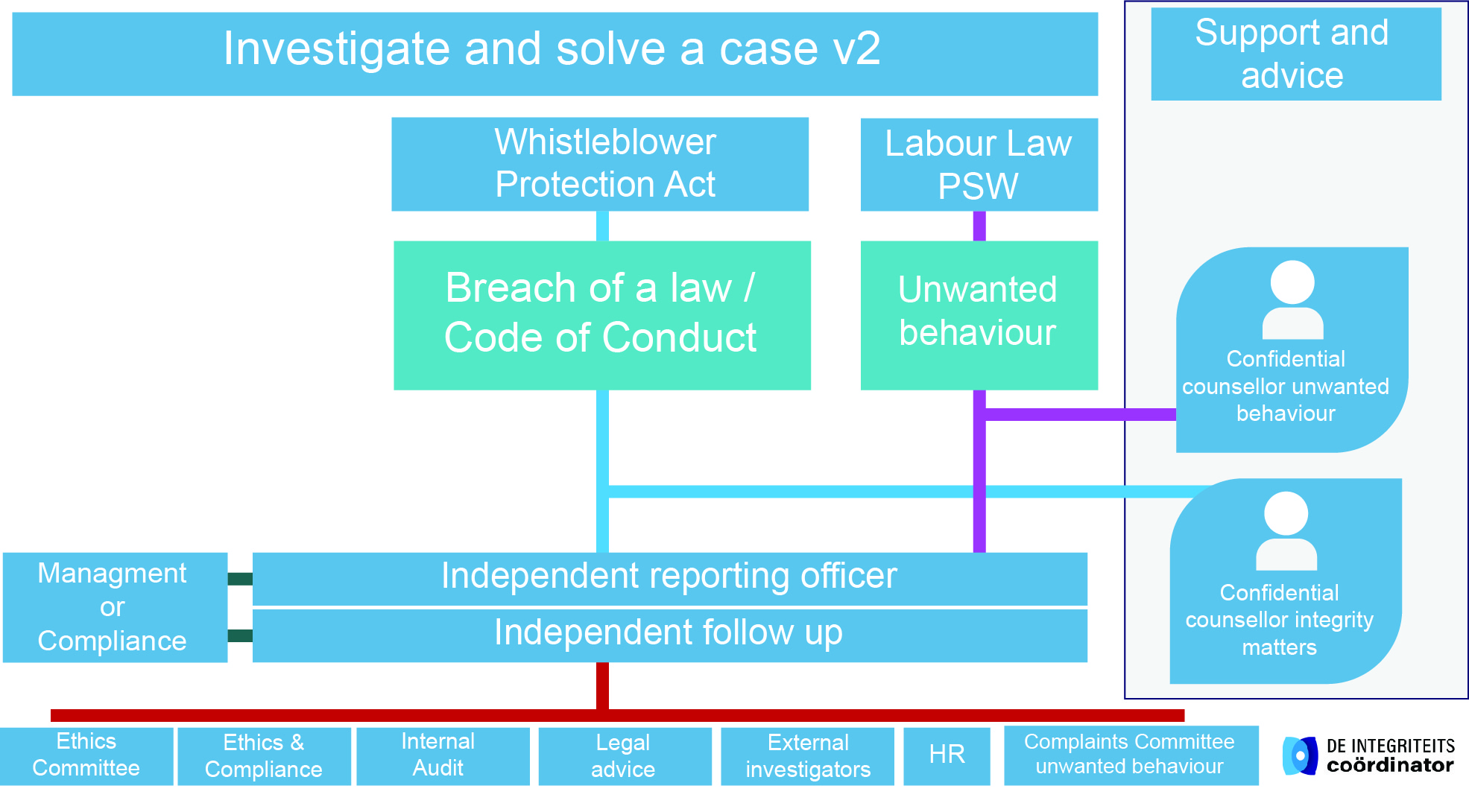
Organisations can choose to also open the reporting channel for reports of unwanted behaviour. In any case, reports about unwanted behaviour can sometimes be whistleblower reports if there is a pattern or structural character that threatens the safety of multiple people or the proper functioning of an organisation. Moreover, it is our experience that an accident rarely comes alone. Fraud or corruption often go hand in hand with intimidating behaviour. Both may result from a particular organisational culture. As an Ethics & Compliance Officer, one would be keen to receive signals on this. It therefore makes sense for the Ethics & Compliance Officer to periodically exchange (anonymised) experiences with the confidential counsellor(s).
It can also happen that an anonymous report about unwanted behaviour is not dealt with by the complaints committee. Even if it is about behaviour that is contrary to the code of conduct. In these cases, the Ethics & Compliance Officer or integrity manager might follow up on it anyway, even if the report does not qualify as a whistleblower report according to the law.
Finally, organisations may also receive reports from the supply chain, for example about environmental pollution or forced (or child) labour during the production process. German companies of a certain size will be obliged to launch these kinds of reporting channels from 2023. Similarly, if you are a supplier to the US government, you are usually contractually obliged to open such a reporting channel. In a few years, all major European companies will have to do so. The obvious thing to do is to use the same reporting channel. More on this in the next article on environmental or human rights violations from the supply chain.

It is equally important to define what cannot be reported through the (whistleblowing) reporting channel. Often, organisations have other channels for customers who want to submit a complaint about the product or service they obtained. Individual labour disputes about an annual review, a missed promotion and the like can usually also not be reported through this channel. Some organisations do use the reporting channel in case an employee loses a computer or a phone, as this often requires immediate action from an IT security or personal data protection perspective. Although the same online reporting form can be used for this, these reports do not have to go to the Ethics & Compliance Officer or the integrity manager.
Do you have other ideas of your own about setting up the reporting channel? We would love to hear about it. You can use our contact form.


